
South African men outspend women in pre-owned luxury market
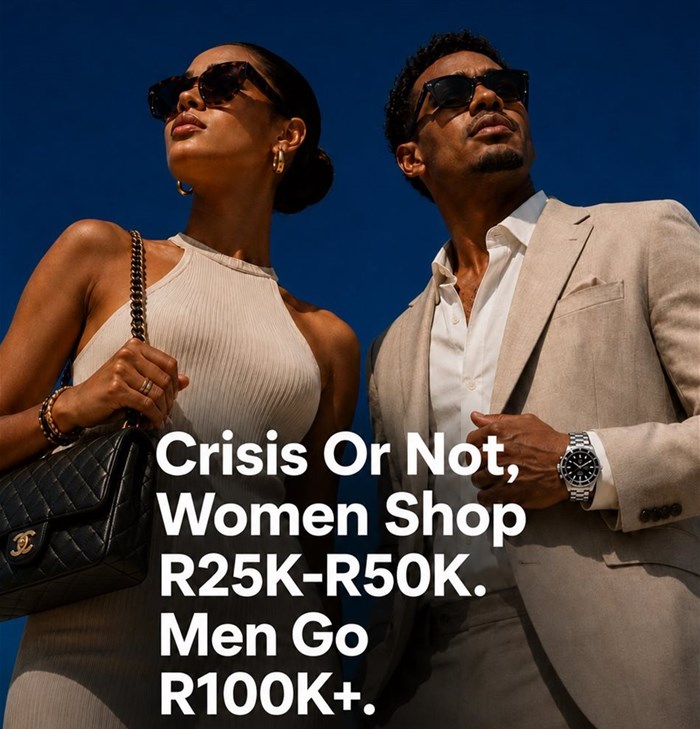
While women have long been the assumed face of the market, new data begs to differ, with men spending bigger, buying faster, and showing a level of brand loyalty that gives even the most devoted handbag collector pause.
Watches draw 48% of male luxury spend. Shoes and apparel take another 36%. Jewellery? A near-invisible 0.3%. Men are not, it turns out, buying bling.
"A watch is one of the few luxury objects a man can wear every day, in almost any context, without it reading as excessive. It signals taste without announcing itself. It holds value. And in the pre-owned market specifically, it can outperform most other asset classes," explains Michael Zahariev, co-founder of Luxity.
Rolex alone accounts for nearly 21% of everything men spend on pre-owned luxury, with TAG Heuer and Breitling following close behind, offering the same mechanical credibility at a slightly more accessible entry point.
"A Submariner or a GMT-Master II isn't just a timepiece," says Zahariev. "It's a piece of horological history with a waiting list at retail and a secondary market that consistently trades above the original price.”
When it comes to women, handbags are having their main-character moment - accounting for 56% of all their pre-owned luxury spend over the past year. Not jewellery, not shoes. Bags. The handbag goes everywhere. It's seen by everyone. And unlike a dress or a pair of heels, it doesn't go out of season
"The handbag is the foundation of a woman's luxury wardrobe: the piece she comes back to, the one she trades up, and the one she passes down. Women aren't buying handbags casually, they're researched, considered purchases. A Hermès Birkin, a Chanel Flap, a Louis Vuitton Neverfull, these are some of the most reliable resale performers in luxury," notes Zahariev.
Women also shop across a wider range of categories, with accessories, jewellery and apparel all featuring. When it comes to brands, Louis Vuitton leads, followed by Gucci, Hermès, Chanel and Cartier, houses with decades of cultural weight and the kind of resale staying power that makes a purchase feel less like spending and more like strategy.
The price points reflect these different instincts. Close to 30% of men's spend goes on pieces priced above R100,000, a concentration at the high end that makes sense when watches and heritage leather goods are your primary categories.
Women's largest spending bracket sits between R25,000 and R50,000, reflecting a wider category mix with more variety, more occasions, more ways in.
The male side of the market is also the faster-growing one. Over the past year, men's pre-owned luxury grew 35% by volume and 52% by value, outpacing women's growth of 20% by volume and 40% by value. Men's items also sell faster, with a median of 24 days from listing to sale compared to 33 for women's.
"Men decide quickly on everyday pieces, but they're far more measured when it comes to high-value purchases," Zahariev highlights. "Women take a slower, more consistent approach."
Whether you're saving for a Submariner or holding out for a Kelly, the South African pre-owned luxury shopper means business. He buys focused. She buys broad. He buys big. She buys often. And neither shows any sign of slowing down.
*The data is based on Luxity’s sales figures from the past 12 months.