


The quiet revolution that just made PR the most powerful discipline in business
For decades, PR sat at the bottom of the boardroom budget conversation. AI search, the new Google, has just changed that forever - and most companies have no idea what is coming for them.
1 Jul 2026

Madelain Roscher, founder and CEO, PR Worx and Public Relations Institute of SA (Prisa) member, examines how AI Search has made PR the most powerful discipline in business (Image supplied)
When Gartner predicted last month that global PR and earned media budgets would double by 2027, the communications industry celebrated.I did not. Doubling is nowhere near enough.
After 25 years of leading South Africa's number one PR agency, I have watched companies chronically underfund their communications function while pouring capital into marketing and advertising that delivers a short-term sugar rush and looks spectacular in a year-end board presentation.
AI search has just delivered the reckoning for that thinking - and it is going to be brutal for the brands that are not ready.
We are not talking about a trend. We are talking about a fundamental restructuring of how the world finds, verifies, and trusts information about your company.
And PR is either your brand’s greatest competitive asset right now or the gap in your strategy that will quietly hollow out your business over the next 36 months.
AI search doesn't reward the loudest brand. It rewards the most credible one
The new information layer your brand doesn't control – yet
Consider what has already happened. Google's AI Overviews now serve more than 2.5 billion monthly active users - approaching a third of the global population.
Only 32% of Google searches now result in a click to a website. The majority of people asking questions about your industry, your competitors, and your company are getting AI-synthesised answers and going no further.
They are not reading your website. They are not seeing your paid media. They are reading what AI has decided is the authoritative version of who you are.
Here is what AI search is drawing on to build that version: earned media. Independent journalism. CEO interviews. Third-party analysts. Industry awards. Speaking engagements. The consistent, attributable public record that a company has built - or failed to build - over years.
Gartner's vendor research shows that more than 95% of cited links in AI-generated answers are non-paid mentions, and nearly a third originate directly from earned media. Paid advertising does not feature.
Brand-owned social posts barely register. What AI trusts is what journalists and credible third parties have independently said about you.
That is not a communications problem. It is a business valuation, market positioning and talent attraction problem, and no amount of retargeting spend will solve it.
The brands that win in AI search won't be the ones that publish the most content. They'll be the ones that publish the sharpest, most credible thinking
What most executives are still getting wrong
The instinct when companies hear this is to generate more content. Brief the agency. Spin up the content calendar. Deploy the AI writing tools that can produce 50 articles a week.
This is precisely the wrong response - and it may actively make things worse.AI search is already drowning in competent-sounding content that carries no distinct point of view. Generative AI has flooded the information layer with well-structured, technically accurate, utterly forgettable material that gives AI search even more weak signals to average out.
When everything sounds the same, nothing stands out - and AI systems, which are essentially sophisticated pattern-recognition engines trained on quality and consensus, will gravitate towards the sources that have established credibility over time.
A brand can publish on its own website that it is a leader in renewable energy, financial services, or healthcare innovation.
AI search will note it. Then it will weigh it against the independent business press, the analyst community, the award citations, consumer reviews, and the conference stage appearances - and the self-declared leadership claim will be diluted accordingly.
The brands that break through will be the ones that have invested in building an external, corroborated, independently verified body of work that AI systems recognise as authoritative.
That is the job description of a serious PR function. And it has never been more commercially critical than it is right now.
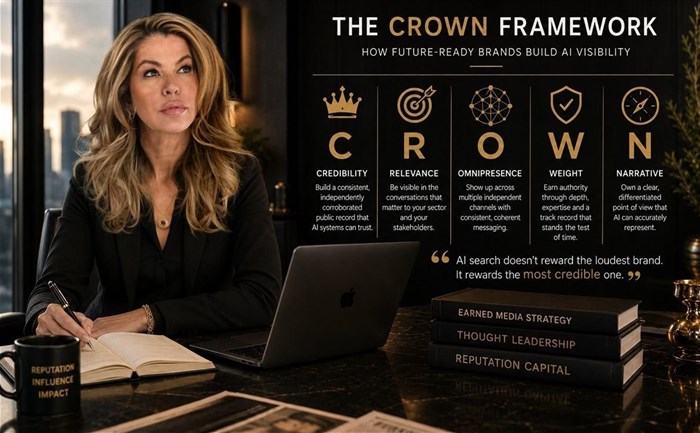
(Image supplied, created by AI)
The crown framework: How future-ready brands are building their AI visibility
At PR Worx, we have spent the past 18-months working through what it actually takes for a brand to establish authority in the AI search era. What emerged is a framework we call CROWN - five disciplines that, together, determine whether AI search becomes your most powerful distribution channel or your biggest reputation risk.
- C – Credibility
The foundation. Without a consistent, independently corroborated public record, AI systems have nothing reliable to reference. This means sustained investment in earned media, thought leadership placement in respected publications, and the kind of third-party validation that no marketing budget can manufacture
- R – Relevance
Being consistently visible in the conversations that matter to your sector. Not broadcast advertising. Not sponsored content. Active, expert presence in the specific topics where your customers, investors, and talent are already asking AI-powered questions
- O – Omnipresence
Showing up across multiple independent channels so that AI systems encounter your brand's narrative from multiple corroborating sources. A single brilliant feature means nothing. A pattern of consistent, coherent coverage across publications, platforms, and formats is what builds machine-readable authority.
- W - Words that work
The quality of the thinking that underpins all of it. Strong PR turns executive knowledge into clear, distinctive arguments. It gives companies a recognisable voice. It moves them beyond the bland category language that AI search ignores. The brands that stand out will be the ones publishing the sharpest thinking, not the highest volume of output.
- N - Never stopThe discipline of consistency. AI search rewards recency and momentum. A brand that ran a strong PR campaign two years ago and then went quiet will find its AI search presence reflecting an outdated, diminished version of itself. This is a long game, and it demands a permanent investment posture, not a project mindset.
Companies that build across all five of these disciplines will find that AI search becomes a compounding asset - each piece of coverage, each thought leadership article, each CEO quote in a trusted publication adds to a growing body of authoritative material that AI systems increasingly reference.
Companies that do not will find themselves described by AI in terms they did not choose, assembled from fragmentary, outdated, or unreliable sources that they have never managed.
PR is no longer about winning attention. It is about shaping the information layer that AI uses to understand who you are
The boardroom conversation that needs to happen today
The most important thing I can tell any CEO, CFO or CMO reading this is straightforward: the competitive window on this is closing faster than you think.
The brands that start investing seriously in their PR and earned media function today - not doubling a historically inadequate budget, but genuinely rethinking the strategic role of communications in the business, will have a meaningful head start on building the kind of AI-visible public record that compounds over time.
The brands that wait until their AI search presence is already damaged will face a significantly harder rebuilding task.
This is not a communications department issue; it is a C-suite strategic imperative. The question is not whether your PR team has a content plan.
The question is whether your board understands that AI search has made earned media one of the highest-return investments in your entire marketing mix - and whether your budget allocations reflect that reality.
After 25 years in the industry as head of PR Worx, I have never been more certain of what is coming.
The companies that treated PR as a grudge purchase are going to look themselves up and not recognise the company that AI has invented for them.
The ones that built their public record with intention and discipline are going to find that AI search does their best marketing for them - every single day, at no additional cost, to an audience they could never reach on their own.
That is not the future of PR. It is already the present. The only question left is which category your company is in.
About Madelain Roscher
Madelain Roscher is the founder and CEO of PR Worx, ranked South Africa's number one PR agency, with 25 years of experience building reputation and communications strategy for the country's leading brands. PR Worx operates through independently owned agencies across Africa.
View my profile and articles...
View my profile and articles...