The strong emergence of Chinese car brands in the South African automotive market has changed the entry-level price point of new cars in the country, according to Toyota South Africa Motors senior public relations manager Riaan Esterhuysen.
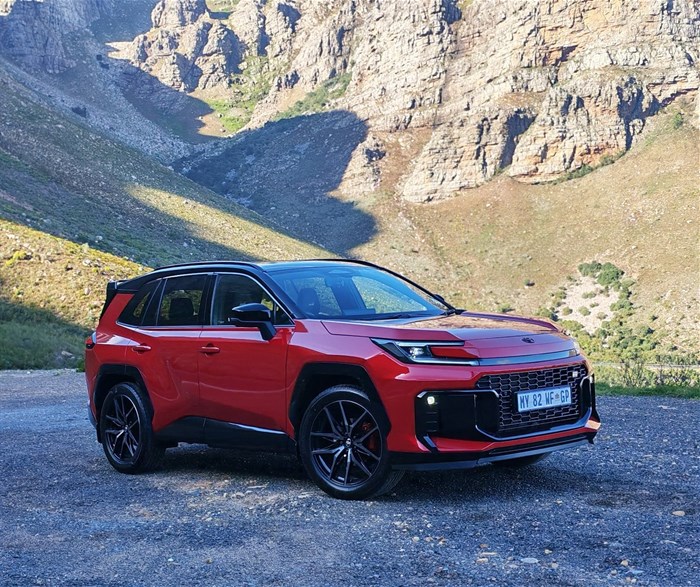
Image credit: Imran Salie
Esterhuysen was responding to a question during a Q&A session at the local launch of the world's best-selling car in 2025, the RAV4. While not a top-seller in the brand's local portfolio, the nameplate is of importance to the brand's multi-pathway strategy.
The question was asked by a member of the media, which addressed the price gap between the new RAV4's range-topping variant and its entry-level one. The new RAV4, in comparison to its predecessor, is a more refined product and therefore is positioned closer to the premium side.
The variant at the top of the range, the 2.5 PHEV, costs R1,043,900, and the HEV GX entry-level model costs R770,500.
Esterhuysen responded by first contextualising the new RAV4's positioning, saying that the nameplate has proverbially grown up. "We intentionally moved it into a more premium space. It occupies or plays in the higher part of the segment now, and that is intentional," he said.
Esterhuysen noted that Chinese car brands in South Africa also played a part in the positioning of the new RAV4. He said that the entry-level price point in South Africa's car market has been captured by brands from the Far East.
"We cannot compete with the emerging Chinese brands directly on an entry-level price point. They have changed that market; they have shaped the market or changed the shape of the market by driving customers down to a lower and mid-tier of the segment or taking used car buyers and upselling them," Esterhuysen said.
Beyond price competitiveness in the entry-level segment, Chinese brands now account for more than 19% of new passenger and light commercial vehicle sales in South Africa, meaning nearly one in five new vehicles sold locally originates from a Chinese brand.
A recent TransUnion Mobility Insights Report also shows that Chinese brands grew sales by 75% year on year in Q1 2026.
More proof that OEMs from the Far East are capturing the affordability segment is that the cheapest NEVs in the country currently are from Chinese brands. The cheapest EV in the country at the moment is the Geely E2, and the cheapest plug-in hybrid is the BYD Atto 2.
A Catch 22 in South Africa's car market
Another interesting topic of discussion arose during the Q&A session. A question was raised regarding public charging infrastructure in the country in light of the new RAV4's powertrain options that include a plug-in hybrid model.
The question was what Toyota is doing to contribute to the public charging infrastructure as NEV adoption grows. Esterhuysen said that all its dealers have been equipped with direct charging but that Toyota at this stage won't be expanding into public infrastructure.
"We believe that that is the role of third-party providers for the same reason OEMs don't own fuel stations," Esterhuysen said. He did, however, also admit that the situation is a tricky one.
"It is a difficult space because you own the charging infrastructure, so do you restrict the infrastructure to your own brand, or don't you? Why, if you're investing, why do you want to enable a competitor, owner or competitor brand to use your infrastructure? It's quite complex," he said.
Esterhuysen likened it to a Catch 22 situation, saying while BEV and PHEV adoption increases in our country, especially with an influx of Chinese NEV models, infrastructure hasn't kept up.
The new RAV4
A month has passed since the new RAV4 launched in the country. In the time from then to now, Toyota also launched its first electric car in South Africa: the bz4X.
At launch, we drove from Cape Town International Airport to Tulbagh, and from there to Paternoster in the various models in the lineup. The sixth-generation RAV4 drove plush and economical while being visually striking.
The petrol range opens with a familiar 2.0-litre naturally aspirated engine (127kW/203Nm), retained largely for buyers who aren't yet sold on electrification.
The hybrid range steps up to a 2.5-litre HEV system producing 137kW/221Nm with a 163kW total system output, built around a new, lighter compact lithium-ion battery.
At the top sits the 2.5 PHEV, running Toyota's sixth-generation plug-in hybrid tech with a 25.4kWh battery, a 225kW total system output and a claimed 142km of electric-only range.
The standout addition is the first-ever RAV4 GR-S, a Gazoo Racing-inspired grade with its own suspension tune, a 15mm lower ride height, reinforced chassis bracing and 20-inch wheels with red brake callipers.
Pricing across the five-grade line-up runs from R770,500 for the HEV GX to R1,043,900 for the range-topping PHEV.